
Are you planning to leave work on time today?

Now in its 18th year, Go Home on Time Day was conceived as a way to start necessary conversations in our workplaces about work/life balance, the value of time, and time theft.

Every year, the Centre for Future Work estimates the value of unpaid overtime that Australian workers are performing in their workplaces.

Download the Go Home on Time Day Report 2026

2026 Data

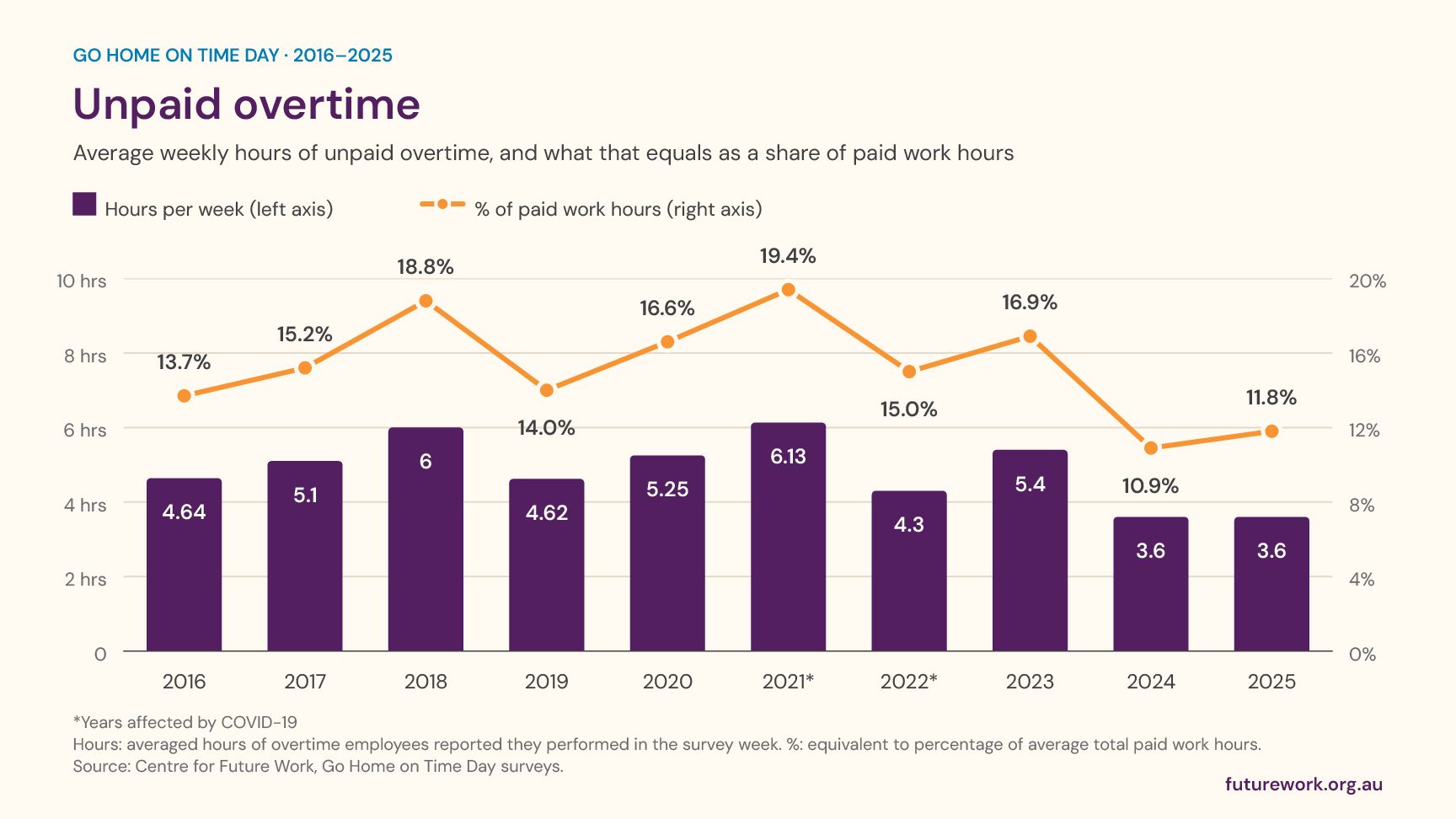
Weekly unpaid overtime hours*

3.2 hours

* Average number of hours overtime employees reported they performed in the week of the survey

Unpaid overtime as a % of paid work hours **

11.8 hours

** Equivalent in percent to their average total paid work hours
Reports

Too much work and too few paid hours?

The 2025 Go Home on Time survey highlights widespread dissatisfaction with paid work hours, and employees working excessive unpaid overtime.

Taking up the right to disconnect?

Unsatisfactory working hours and unpaid overtime: 2024 update

Short Changed

Despite record-low unemployment, Australian employers are still managing to steal more than 280 hours from their employees each year.

News & Articles

GoHomeOnTimeDay2025

Go Home on Time Day 2025: As full timers disconnect, part timers are doing more unpaid overtime

Australians are still doing more than three and a half hours of unpaid overtime each...
Go home on time day

Employers steal more than 280 hours from workers each year: Go Home on Time Day report 2023

The 15th annual Go Home on Time Day (GHOTD) shines a spotlight on the maldistribution...
Go Home on Time Day 2022

Australians working 6 weeks unpaid overtime, costing economy over $92 billion: Go Home on Time Day report

Australian workers are on average working 6 weeks unpaid overtime per year, costing over $92...

‘The number one reason employees are working additional hours is that they can’t complete the work assigned to them in paid hours. That’s not an individual capability issue – that’s a structural problem in the workplace.’ 

Dr Fiona Macdonald